Federal government misses European deadline
The future Energy Industry Act (EnWG) provides a new framework for this transition away from fossil gas and the roll-out of alternatives. Time pressure is coming from the EU via its Directive on the internal markets for renewable gas, natural gas and hydrogen, which must be transposed into German law by 5 August. Berlin will miss this deadline.
Although a draft (EnWG-E) has been available since March, it did not make it onto the Bundestag’s agenda before the summer recess.
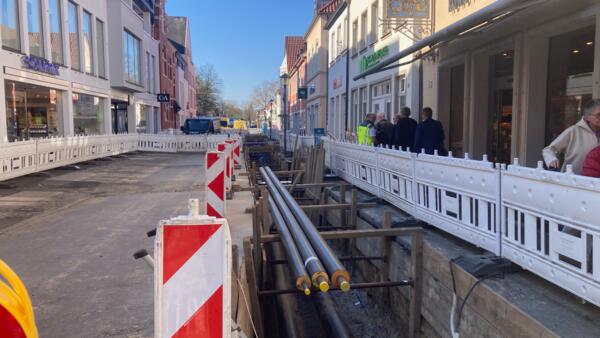
However, one major concern for the gas industry appears to have already been put to rest. The federal government is not calling for the dismantling of the gas networks. The pipes may remain in the ground, as this would otherwise have led to countless construction sites and costs running into the billions across the country. “Anything else would be an absolute disaster. And I would also find it foolish, because we should use these pipeline systems in future for fibre-optic roll-out or other cable laying,” Arndt Müller, a member of the executive board at Stadtwerke Trier, explained in an interview with energate. Björn Güldenarm, authorised signatory and Technical Director at Stadtwerke Warendorf, shares this view.
Long notice periods for gas network disconnection
The draft Energy Industry Act (EnWG) adopts a requirement from the European directive verbatim: network operators must give ten years’ notice of decommissioning. There has been some harsh criticism from within the industry that this long lead time could undermine flexible network planning. For Müller and Güldenarm, however, this is justifiable in the interests of gas consumers. “On the other hand, there are the customers who have to prepare for the decommissioning. Anything else would perhaps be a bit like holding a gun to their heads,” Warendorf manager Güldenarm says. In Trier, the municipal utility is already engaging with customers at an early stage. Priority is given to those whose gas network is, in theory, due for renewal. “We’re obviously not investing just to shut it down ten years later,” Müller says.
In his view, it is important to link the announcement of the end of gas supply with concrete alternatives. The Rhineland-Palatinate utility is currently developing a contracting scheme in collaboration with trade association members. “The first step will be for an energy adviser, at our expense, to visit the homes due for conversion. They will assess whether the building is already suitable for a heat pump or whether – if it makes economic sense – investments should first be made in radiators, windows or external insulation,” Müller explained. Should households find the alternative decentralised heating solution financially unmanageable, the contracting model is intended to help. Households would thus not have to pay a five-figure euro sum for a new heat pump in one go, but rather a fixed monthly amount. Müller roughly estimates that between 25 and 30 per cent of households might need to rely on this scheme. To finance this, he can also envisage community-based models using subordinated loans, as are already common in the wind power sector.
In Warendorf, however, no plans for communicating with customers have yet been drawn up, even though the district heating network has been under construction for some time. “Our gas network is very densely meshed; removing individual pipeline sections would cause problems with supplying the network,” Güldenarm explained.
How much of the gas network will remain?
In this North Rhine-Westphalian municipality, the municipal utility is building a district heating network
that will be entirely green thanks to a large-scale river water heat pump. With a heat unit price of 14.5 cents, the municipal utility is trying to persuade its gas customers to say goodbye to their fossil-fuel heating systems. However, the technical manager suspected that the district heating and gas networks would continue to operate in parallel for many years to come – at least as long as this remains economically viable. “The option to choose is a matter of political will. So, it will be some time yet before we send out the first letters,” he explained in an interview with energate.
As a major city with over 100,000 inhabitants, Trier has already had to finalise its heating plan; the direction here is clear. Roughly estimated, around 30 to 40 per cent of the gas network will be retained as a “future core network”, Müller, the sole board member, explained.
These are often high- and medium-pressure pipelines that can also be used for storage. In future, the municipal utility intends to feed biomethane into the network in summer, gradually increase the pressure in the network to up to 55 bar, and then draw it off for its combined heat and power plants in winter.
Two biomethane zones have already been designated: one in the city centre and another in a different part of Trier, where much of the gas network had to be rebuilt following flooding just five years ago. Seven biogas plants are already in operation, with four more in the implementation phase, including a new processing plant. “By 2045, we will need 220 million kWh of green gases – that is three times the current volume,” Müller predicted. He is not concerned about soaring gas network charges or the cost of biomethane.
Distribution network development plans with neighbouring regions
According to the draft Energy Industry Act (EnWG), network operators will in future be required to draw up so-called distribution network development plans at intervals of at least every four years. In Trier, the aim is to update these plans more frequently, every two years. Both municipal utilities intend to capitalise on synergies with neighbouring network operators or the upstream long-distance gas network operator. “It’s in our DNA to try and develop things together with our neighbours,” Güldenarm said.
The fact that many applications for biomethane connections are being made in gas network areas where decommissioning is actually on the cards is not a problem for either municipal utility. The current draft provides that distribution network operators
can terminate network connections for biomethane plants with
just ten years’ notice and without compensation. There could well still be some changes here during the parliamentary process, according to reports from Berlin. /mt
You can read the full interview with Arndt Müller, CEO of Stadtwerke Trier, in today’s Gas & Heat add-on. Part two, featuring Stadtwerke Warendorf, will follow on 27 July.